The Most Expensive 37 Minutes
The Most Expensive 37 Minutes in the Workday Has Nothing to Do with Meetings or Workloads.

By: DB Bedford | Chief Behavioral Strategist
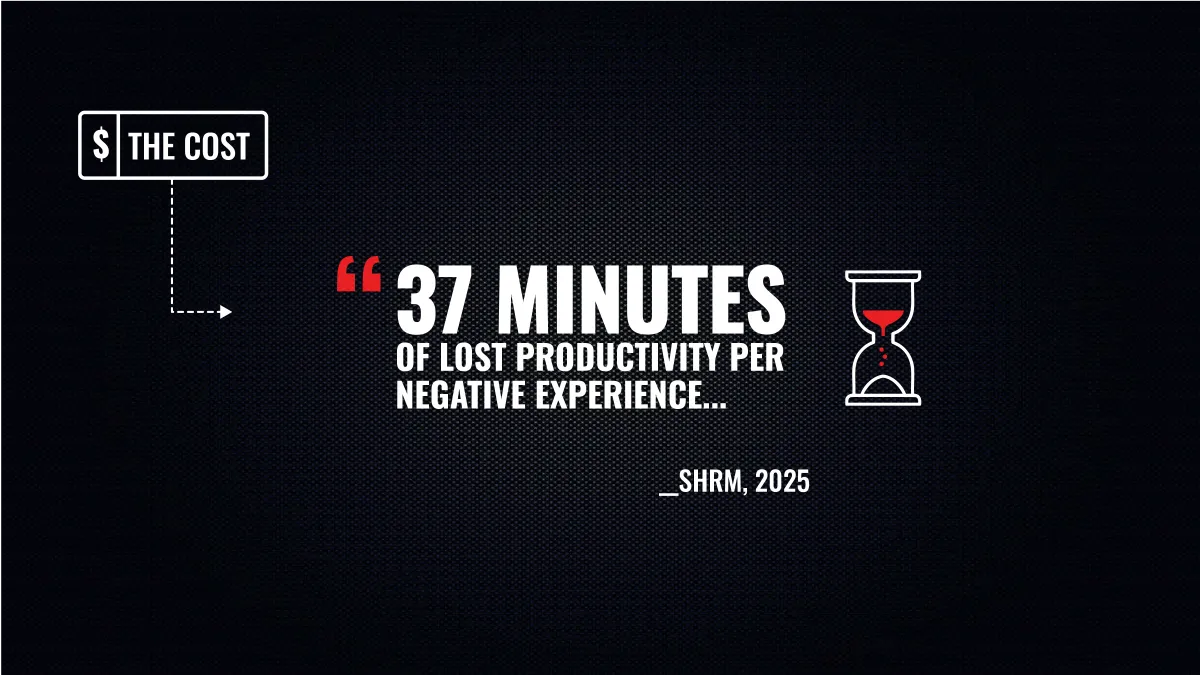
The most expensive minutes in your workday don’t show up on a calendar or a task list. They don’t come from meetings that run long or workloads that feel heavy. They begin the moment a tense interaction lands—an abrupt email, a dismissive comment, a tone that signals disrespect. Research shows that after a negative or uncivil interaction, employees lose an average of 37 minutes of productive focus. Work keeps moving, but clarity slips. The energy in the room shifts, attention starts to wander, and performance quietly takes a hit.
Picture this: A team meeting wraps up with a subtle jab that no one addresses. There’s no argument, no blow-up, so everyone moves on… or at least it appears that way. Later, someone overhears a rumor about themselves in the hallway. Then there’s that moment when two people reach the door at the same time and one chooses not to hold it open. Small things are easy to dismiss but don't think they just disappear.
Meanwhile, someone sits at their desk trying to focus on a report, but their mind keeps drifting back to the comment, the rumor, the moment at the door. Another colleague pulls back, choosing silence over engagement for the rest of the day. A manager feels the shift in the room with less energy, less openness but can’t quite name what changed. By the afternoon, the work gets done much slower and something is clearly missing.
Now imagine those moments repeating across teams and across days. None of it feels dramatic enough to call out, but the cost adds up fast as focus starts to slip, collaboration tightens, and emotional fatigue sets in. One small uncivil moment at a time quietly drains productivity until you realize you’ve been losing 37 minutes here, 37 minutes there, every single day.
The solution isn’t pushing people harder or stacking more work on already full plates. Most teams aren’t struggling because they don’t care, they’re struggling because no one ever trained them how to show up when pressure is high and emotions are activated.
When organizations slow down just enough to measure their civility climate, something important happens. The guesswork disappears. Teams gain language for what they’re experiencing, and leaders gain visibility into where tension is quietly draining energy. Add practical tools for emotional regulation and intentional communication, and those costly minutes stop slipping through the cracks.
Civility Intelligence™ makes the invisible feel visible. It helps leaders and teams recognize friction early, recover faster after tense moments, and collaborate with more clarity and respect. Because the most expensive minutes in the workday aren’t just unavoidable side effects of work, they’re preventable when culture is designed, not assumed.
What makes this challenge so costly isn’t that leaders don’t care, it’s that most are operating without the skill of neutralizing behavior. Culture is felt every day, but rarely measured. And when something isn’t measured, it’s managed by assumption, anecdotes, or gut instinct. That’s where organizations lose time, trust, and traction without ever seeing it happen.
This is where the Civility Index™ changes the conversation.
The Civility Index™ is a behavioral observation tool designed to reveal what your workplace climate is actually reflecting right now. In just a few minutes, it helps you see whether your environment naturally promotes civility and healthy interaction, or whether it spends more time quietly neutralizing incivility after the fact. Before you invest another hour in meetings, initiatives, or morale conversations, take three minutes to understand the climate your people walk into every day. Because the most expensive minutes in the workday aren’t hidden forever they’re waiting to be measured.
Take the Civility Index™ today and see what your workplace climate is really telling you.